
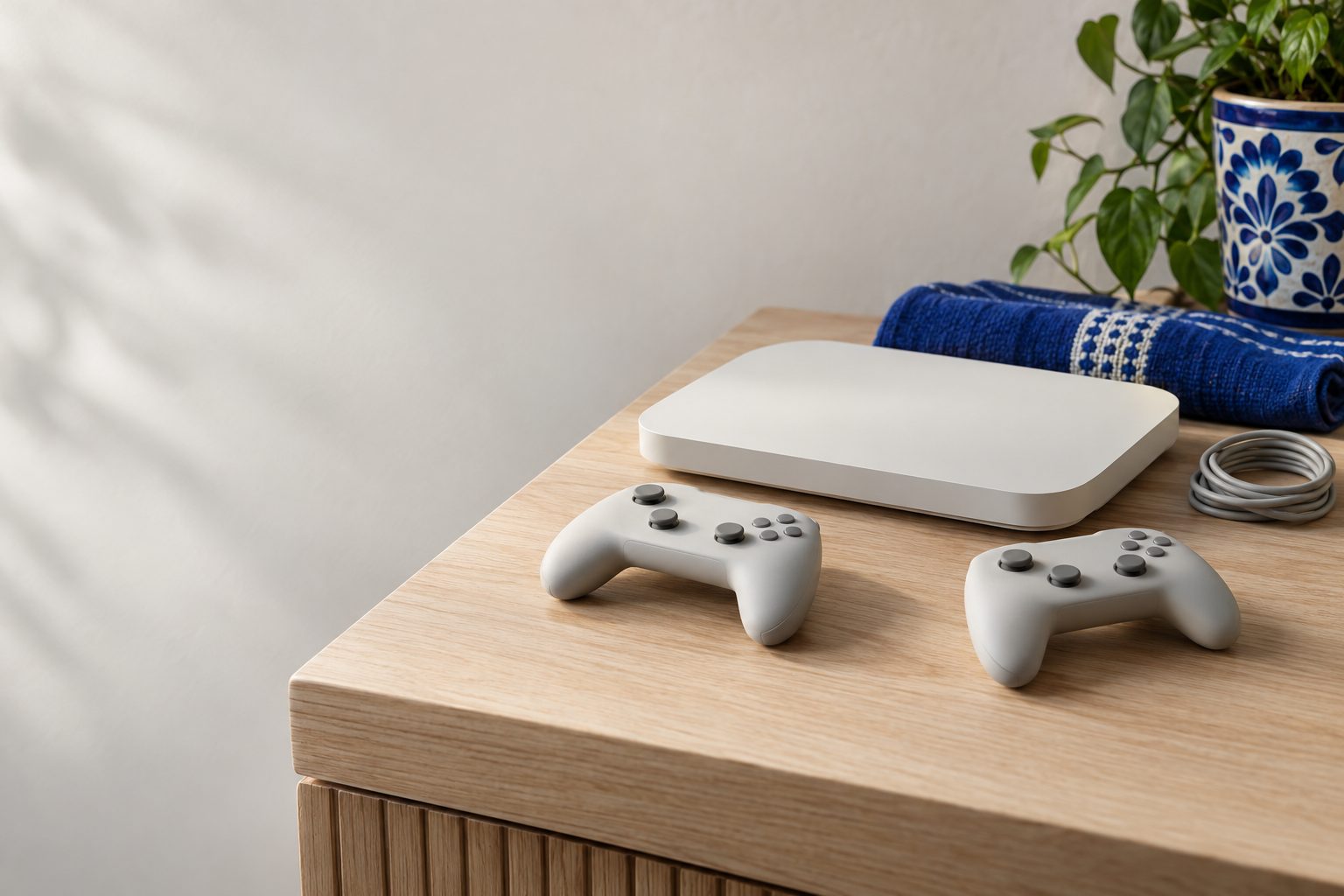
Prices checked on 4 November 2026 across the shops Reacondi compares, in Mexican pesos. Anyone searching for a "refurbished Switch 2" finds today that, among the shops Reacondi compares, there is none. In our check of 27 October there was one at XMKT, and that offer is gone. What there is are the three earlier Switch models, the Lite, the standard and the OLED, from $2,010, and the new Switch 2 from $11,839. This guide compares those four with what Nintendo says about each, explains which battery to ask for on the standard one, and says when it makes sense to pay the difference for the Switch 2. What to check on any used console, such as account bans and drifting sticks, is in what to check when buying a refurbished console.
The prices on 4 November
| Console | Refurbished, from | New, from | Shops with refurbished |
|---|---|---|---|
| Nintendo Switch Lite | $2,010 | $4,419 (32 GB, JP version) | 1 |
| Nintendo Switch | $2,400 | $6,499 (32 GB, JP version) | 2 |
| Nintendo Switch OLED | $3,060 | $6,389 (64 GB) | 2 |
| Nintendo Switch 2 | no offer | $11,839 (256 GB) | 0 |
The refurbished ones come from two shops. Tienda Dondé has the cheapest of the three, all "Seminuevo" [pre-owned] with "Garantía de 5 días" [5-day warranty], and the listings for the cheapest Lite and OLED say "Solo entrega en sucursal" [pickup at the branch only]. XMKT sells the standard one at $2,999 and the OLED at $3,999, both "XMKT Certified" with "12 meses de garantía XMKT" [12-month XMKT warranty]. The new ones are from Doto with a 6-month warranty, and the Lite and the standard are advertised as the JP version. What changes with a console from another region is explained in the consoles guide. Coppel also lists a new Switch 2 at $11,799, with no warranty in what we read, which is why it is not in the "from" price. The condition and the warranty are each shop's words, not an inspection by us, and the grade guide says what each one means.
 Nintendo Switch Lite
Refurbished, from$2,010
1 shopSee prices →
 Nintendo Switch
Refurbished, from$2,400
2 shopsSee prices →
 Nintendo Switch OLED
Refurbished, from$3,060
2 shopsSee prices →
 Nintendo Switch 2
New, from$11,839
1 shopSee prices →
What changes between them
According to Nintendo's specifications page, the three earlier Switch models have a 1280 x 720 screen and accept microSD cards of up to 2 TB, sold separately. What changes is the screen size, the internal memory and whether they connect to the TV.
- The Switch Lite has a 5.5-inch screen, 32 GB and weighs 277 g. Nintendo lists no video output for it and says its USB-C port is used only to charge the battery, so it is played only in the hands.
- The standard Switch has a 6.2-inch screen, 32 GB, and weighs 299 g alone and 399 g with the Joy-Con attached. With its dock it connects to the TV at up to 1080p.
- The Switch OLED has a 7.0-inch OLED screen, 64 GB, and weighs 322 g alone and 426 g with the Joy-Con. It also connects to the TV at up to 1080p.
Between the standard and the OLED there is $660 of difference in what we found, from $2,400 to $3,060. For that money the internal memory doubles and the screen is bigger, but the resolution is the same.
The battery of the standard one
Nintendo publishes two approximate durations for two versions of the standard Switch. The HAC-001, with a serial number that starts with "XAW", lasts 2.5 to 6.5 hours. The HAC-001(-01), with a serial that starts with "XKW", lasts 4.5 to 9. The OLED, with a serial that starts with "XTW", also 4.5 to 9 hours, and the Lite 3 to 7. The listings of the shops we checked do not say which of the two versions is the standard one they sell, so ask before you pay.
Nintendo adds that, with use, the battery goes down over time and that after about 800 charge cycles it lasts around 80% of what it lasts on a new console. Nintendo calls it normal and says it does not indicate a problem with the console, and a used console has already piled up charge cycles. Charge the console fully as soon as it arrives and see how long it lasts at the brightness you will use.
And the Switch 2
Nintendo lists for the Switch 2 a 7.9-inch LCD screen at 1920 x 1080 with HDR10 and variable refresh rate of up to 120 Hz, 256 GB of internal memory and TV output of up to 4K at 60 fps. Nintendo gives its battery approximately 2 to 6.5 hours, against 4.5 to 9 for the OLED.
For someone who already has Switch games, Nintendo says the Switch 2 plays the physical and digital games of the Switch, although it states that some may not be fully compatible, and that its hardware is different. There are other differences you notice when changing consoles. For saving games and data, the Switch 2 only accepts microSD Express cards, and a microSD you already used in a Switch does not let you save or load digital games or save data on it. The Switch Joy-Con can be synced with the Switch 2, but they do not attach to it, and Nintendo says the Switch dock and the HDMI cable that came with it are not compatible with the Switch 2.
If your reason to buy is to play the games that are exclusive to the Switch 2, there is no refurbished alternative today among the shops we compare. If it is to play the Switch catalog on the TV or in your hands, the difference against a refurbished OLED is $8,779, according to the prices of 4 November.
Which one to choose
- For a child who will play in the hands, the Lite, the cheapest of the four, with the warning that the Dondé listing says "Solo entrega en sucursal" and that it lasts 3 to 7 hours.
- To play on the TV and away from home spending little, the standard one. Ask for the battery version, and prefer the XMKT one if you want 12 months of warranty for $599 more than the lowest price.
- For the biggest screen of the three earlier Switch models and the 64 GB of memory, the OLED, from $3,060 with 5 days of warranty at Dondé or $3,999 with 12 months at XMKT.
- If you want the Switch 2, today there is only new among the shops we compare, and the prices by shop are on the model page.
On the day it arrives, follow what to check on arrival and the deadline rules in your rights when buying refurbished. All consoles are in consoles.
Sources
- Prices, shops, conditions and warranties: offers read by Reacondi on 4 November 2026.
- Nintendo Mexico, Nintendo Switch tech specs and the OLED's in the United States
- Nintendo, Nintendo Switch 2 tech specs
- Nintendo, Nintendo Switch battery life
- Nintendo, compatibility of Nintendo Switch with Nintendo Switch 2
- Nintendo, microSD and microSD Express card compatibility
- Nintendo, transferring games to Nintendo Switch 2
The prices in the text are those of 4 November 2026 and change daily; the cards show today's. Prices are rounded to the peso. We did not test the consoles. The specifications are those Nintendo publishes, and the unit you receive may be from another region, capacity or version.